Bardet-Biedl Syndrome

BBS overview

Actor portrayal
Girl sitting at kitchen counter and eating. Actor portrayal.

BBS ciliary dysfunction impairs various systems throughout the body1,2

Bardet-Biedl syndrome (BBS) is a rare autosomal recessive ciliopathy that is clinically and genetically diverse.3

Two key features among a wide range of symptoms

Hyperphagia and obesity are among the common features of BBS that can seriously impact the overall health and quality of life of these patients.4,5

Plate with fork and knife to represent hunger icon

Hyperphagia6-8

Chronic pathological condition characterized by insatiable hunger, impaired satiety, and persistent abnormal food-seeking behaviors.

Baby icon

Early-onset obesity6,9-13

Early-onset obesity may develop as early as 2 years old, often appearing in early childhood and continuing into adolescence and adulthood.

Signs and symptoms of BBS

Primary cilia dysfunction within each organ system contributes to the highly variable phenotype in BBS, which evolves significantly during childhood and into adolescence.3

Bardet-Biedl syndrome (BBS) brain icon

Brain3

  • Hyperphagia*
  • Obesity (any age) 72–92% or overweight (<2 years old) 55%
  • Cognitive and neurodevelopmental manifestations 67–72%
Kidneys icon

Kidneys3

  • CAKUT 26–81% or
    CKD 31–39%
Reproductive icon

Reproductive3

  • Hypogonadism 34–47% 
  • Genital anomalies 20–70% 
Eye icon

Eyes3

  • Retinal dystrophy 87–97% 
Skeletal icon

Skeletal3

  • Postaxial polydactyly 75% 

Additional clinical features of BBS may include3:

  • Brain: speech delay, developmental delay, ataxia/poor coordination, anosmia/hyposmia
  • Skeletal: dental anomalies, brachydactyly, syndactyly, craniofacial dysmorphisms
  • Body organs: laterality defects 
  • Hearing: conductive or sensorineural hearing loss 

Heart defects may be observed in BBS patients.4

Signs and symptoms of BBS body image

Hyperphagia is a common manifestation of BBS resulting from impairment of the MC4R pathway. Although hyperphagia is not used as a diagnostic criterion for BBS, it may be an early indicator and can substantially affect patient health and quality of life.

Lightbulb icon

People living with BBS and their families often gain a sense of relief in knowing there is an underlying cause of their symptoms unrelated to environmental and lifestyle factors. Early identification allows patients and families to plan, prepare, and better manage their disease.5,6

STILL NOT ENOUGH brain image
It’s a constant need to eat. And that’s when she started sneaking foods... We ended up getting some locks and putting them on our pantry and on the fridge.

– Caregiver of an individual living with BBS

Causes of BBS

Typical mode of inheritance18-20

Affected individuals have a variant in both copies of a BBS gene. Nearly 30 genes have been found to be associated with BBS.17,18

Bardet-Biedl syndrome (BBS) is inherited in an autosomal recessive manner. Affected individuals have a variant in both copies of a Bardet-Biedl syndrome (BBS) gene, meaning the parents of the affected individual were likely carriers of a single variant.

Mechanism of disease

Ciliary dysfunction in BBS can lead to impairment of the melanocortin-4 receptor (MC4R) pathway—an underlying cause of obesity in BBS—setting it apart from general obesity.1,2,4,14

The MC4R pathway regulates hunger, satiety, and energy expenditure.1,6,22
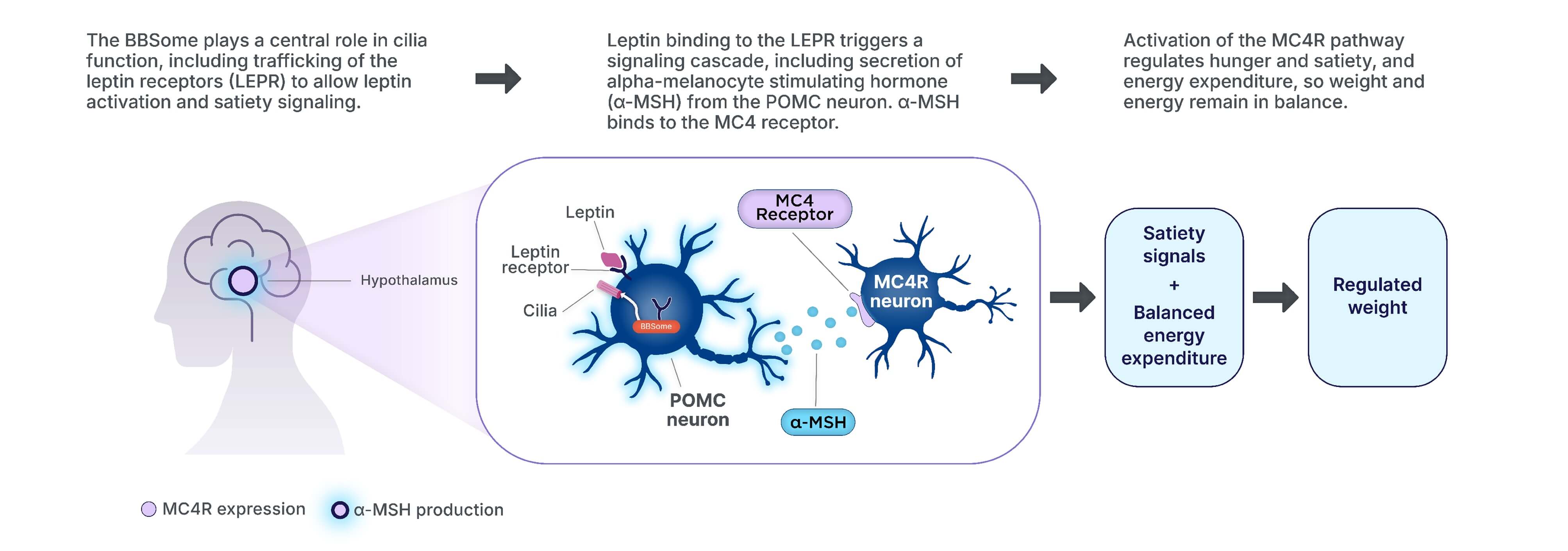
The Bardet-Biedl syndrome (BBS)ome plays a central role in cilia function, allowing leptin activation and satiety signaling. Leptin binding to the LEPR triggers a signaling cascade that includes the secretion of alpha-melanocytestimulating hormone from the POMC neuron that binds to the MC4 receptor. This activation of the MC4R pathway regulates hunger, satiety, and energy expenditure, so weight and energy remain in balance.
Loss of BBS gene function can impair MC4R pathway signaling, ultimately
leading to hyperphagia and early-onset obesity.1,6,23
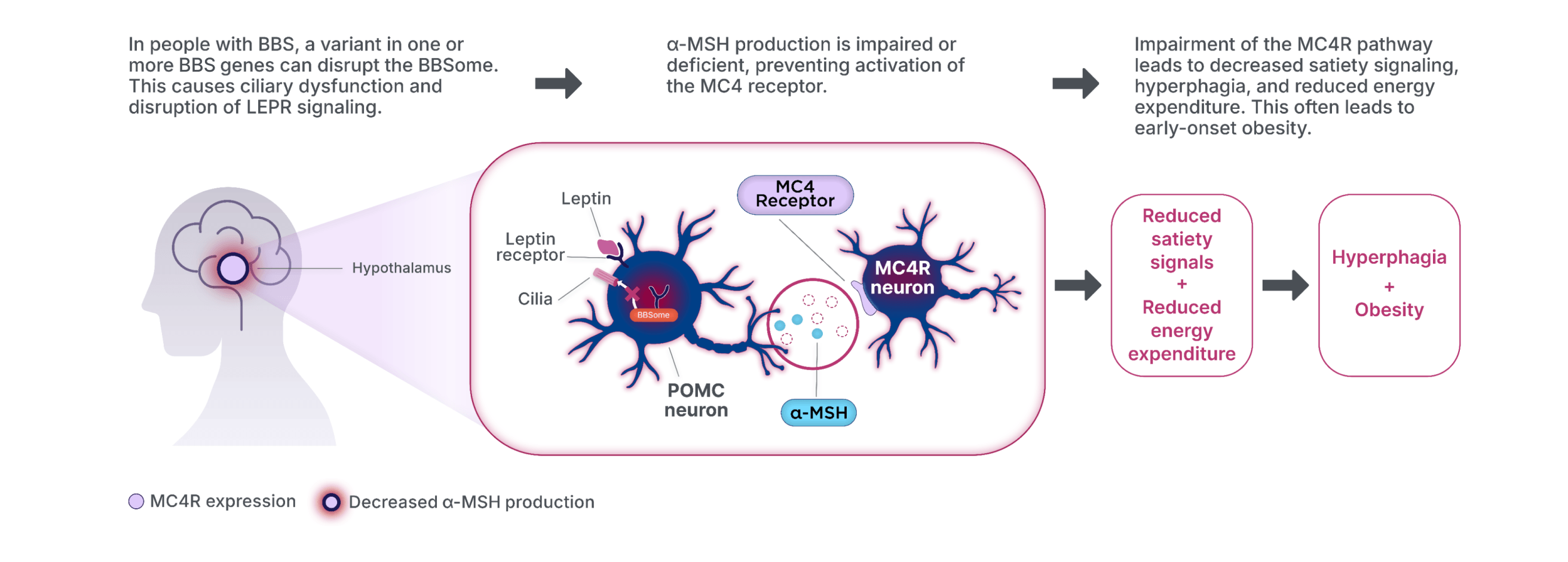
In people with Bardet-Biedl syndrome (BBS), a variant in one or more Bardet-Biedl syndrome (BBS) genes can disrupt the Bardet-Biedl syndrome (BBS)ome, leading to ciliary dysfunction and disruption of LEPR signaling. Alpha-melanocyte-stimulating hormone production is impaired or deficient, which prevents activation of the MC4 receptor and impairment of the MC4R pathway. This leads to decreased satiety signaling, hyperphagia, and reduced energy expenditure, all of which can lead to early-onset obesity.

POMC=Proopiomelanocortin

Take a deeper look inside the MC4R pathway

See the role of the MC4R pathway in driving obesity and hyperphagia in people living with BBS.

MC4R pathway video thumbnail

MC4R pathway video

Questions about BBS?

References
  1. Blaess S, Wachten D. The BBSome: a nexus controlling energy metabolism in the brain. J Clin Invest. 2021;131(8):e148903. doi:10.1172/JCI148903
  2. Pala R, Alomari N, Nauli SM. Primary cilium-dependent signaling mechanisms. Int J Mol Sci. 2017 Oct 28;18(11):2272. doi:10.3390/ijms18112272
  3. Pomeroy JJ, Richards J, Sweeney BR, et al. Streamlining diagnosis of Bardet-Biedl syndrome: new diagnostic algorithm with updated criteria. Am J Med Genet A. Published online May 23, 2026. doi:10.1002/ajmg.a.70199
  4. Forsythe E, Kenny J, Bacchelli C, et al. Managing Bardet-Biedl syndrome–now and in the future. Front Pediatr. 2018;6:23. doi:10.3389/fped.2018.00023
  5. Forsythe E, Mallya UG, Yang M, et al. Burden of hyperphagia and obesity in Bardet–Biedl syndrome: a multicountry survey. Orphanet J Rare Dis. 2023 Jan 16;18(1):12. doi:10.1186/s13023-023-02723-4
  6. Eneli I, Xu J, Webster M, et al. Tracing the effect of the melanocortin-4 receptor pathway in obesity: study design and methodology of the TEMPO registry. Appl Clin Genet. 2019 Jun 5;12:87-93. doi:10.2147/TACG.S199092
  7. Hampl SE, Hassink SG, Skinner AC, et al. Clinical practice guideline for the evaluation and treatment of children and adolescents with obesity. Pediatrics. 2023;151(2):e2022060640. doi:10.1542/peds.2022-060640
  8. Heymsfield SB, Clément K, Dubern B, et al. Defining hyperphagia for improved diagnosis and management of MC4R pathway-associated disease: a roundtable summary. Curr Obes Rep. 2025;14(1):13. Published 2025 Jan 25. doi:10.1007/s13679-024-00601-z
  9. Shoemaker AH, Tamaroff J. Approach to the patient with hypothalamic obesity. J Clin Endocrinol Metab. 2023;108(5):1236-1242. doi:10.1210/clinem/dgac678
  10. Forsythe E, Beales PL. Bardet-Biedl syndrome. Eur J Hum Genet. 2013;21(1):8-13. doi:10.1038/ejhg.2012.115
  11. Pomeroy J, Krentz AD, Richardson JG, Berg RL, VanWormer JJ, Haws RM. Bardet-Biedl syndrome: weight patterns and genetics in a rare obesity syndrome. Pediatr Obes. 2021 Feb;16(2):e12703. doi:10.1111/ijpo.12703
  12. Sherafat-Kazemzadeh R, Ivey L, Kahn SR, et al. Hyperphagia among patients with Bardet-Biedl syndrome. Pediatr Obes. 2013 Oct;8(5):e64-7. doi:10.1111/j.2047-6310.2013.00182
  13. Katsanis N, Ansley SJ, Badano JL, et al. Triallelic inheritance in Bardet-Biedl syndrome, a Mendelian recessive disorder. Science. 2001;293(5538):2256-2259. doi:10.1126/science.1063525
  14. Zaghloul NA, Katsanis N. Mechanistic insights into Bardet-Biedl syndrome, a model ciliopathy. J Clin Invest. 2009;119(3):428-437. doi:10.1172/JCI37041
  15. Forsythe E, Sparks K, Best S, et al. Risk factors for severe renal disease in Bardet-Biedl syndrome. J Am Soc Nephrol. 2017;28(3):963-970. doi:10.1681/ASN.2015091029
  16. Florea L, Caba L, Gorduza EV. Bardet-Biedl syndrome–multiple kaleidoscope images: insight into mechanisms of genotype-phenotype correlations. Genes (Basel). 2021;12(9):1353. doi:10.3390/genes12091353
  17. Beales PL, Elcioglu N, Woolf AS, Parker D, Flinter FA. New criteria for improved diagnosis of Bardet-Biedl syndrome: results of a population survey. J Med Genet. 1999;36(6):437-446.
  18. Dollfus H, Lilien MR, Maffei P, et al. Bardet-Biedl syndrome improved diagnosis criteria and management: Inter European Reference Networks consensus statement and recommendations. Eur J Hum Genet. 2024 Jul 31;32(11):1347-1360. doi:10.1038/s41431-024-01634-7
  19. Uncovering Rare Obesity Program. Uncovering Rare Obesity. https://uncoveringrareobesity.com
  20. National Institutes of Health. Bardet-Biedl syndrome. MedlinePlus. Updated August 18, 2020. Accessed March 31, 2025. https://medlineplus.gov/genetics/condition/bardet-biedl-syndrome/#inheritance
  21. Richards S, Aziz N, Bale S, et al. Standards and guidelines for the interpretation of sequence variants: a joint consensus recommendation of the American College of Medical Genetics and Genomics and the Association for Molecular Pathology. Genet Med. 2015;17(5):405-424. doi:10.1038/gim.2015.30
  22. Seo S, Guo DF, Bugge K, Morgan DA, Rahmouni K, Sheffield VC. Requirement of Bardet-Biedl syndrome proteins for leptin receptor signaling. Hum Mol Genet. 2009;18(7):1323-1331. doi:10.1093/hmg/ddp031
  23. Huvenne H, Dubern B, Clément K, Poitou C. Rare genetic forms of obesity: clinical approach and current treatments in 2016. Obes Facts. 2016;9(3):158-173. doi:10.1159/000445061